Your best ideas never leave your machine.
Quantery is a desktop quant & backtesting engine for serious retail investors. Build theses, screen the entire US market, and run unlimited point-in-time backtests — entirely on your own computer. Bring your own AI and market-data keys; your research, your edge, and your data never touch anyone else's servers.
One-time perpetual license — $249 launch price (reg. $499). First year of updates included. Runs forever offline — macOS, Windows & Linux.
| Symbol | P/TBV | Quant | Composite | Verdict |
|---|---|---|---|---|
| ACME | 0.82 | 11 | 17 | STRONG |
| NDMO | 1.04 | 10 | 14 | WATCH |
| FICT | 1.19 | 9 | 12 | WATCH |
| SMPL | 0.71 | 12 | 9 | PASS |
Why serious retail investors run it local
Online screeners and backtesters want a subscription — and a look at your best ideas — in exchange. Quantery flips that: you own the tool, and nothing leaves your desk.
-
Your edge stays yours
Your theses, screens, and results live only on your machine. You never upload your best ideas to someone else's platform to have them logged, ranked, or resold. Private by construction.
-
No subscription treadmill
Buy the license once and run unlimited scans and backtests forever — no per-backtest metering, no four-figure annual bill, no features held behind a higher tier.
-
Private & offline by default
The whole engine runs on your desktop. Bring your own data and AI keys and use them directly — or work fully offline against the history you've already pulled.
How it works
Think of it as a refinery: raw filings and prices go in, tested theses come out. You turn the crank.
-
1
Define a thesis
Describe what you're hunting — from a one-line idea to a multi-factor model with universe filters, scoring criteria, hard gates, and verdict bands. Ships with templates: deep-value capitulation, Graham net-net, Piotroski F-score, Magic Formula, Buffett-quality, earnings-yield.
-
2
Scan the universe
Evaluate the whole US equity universe against point-in-time fundamentals from primary SEC filings — as they were actually reported, no restatement leak.
-
3
Backtest walk-forward
Replay the thesis across history — as many times as you want — with survivorship-aware, anti-look-ahead safeguards. Event study plus a naive portfolio, benchmarked against SPY or IWM (one benchmark per run).
-
4
Optionally AI-score
Bring your own AI — Claude, OpenAI, or a local model — to score the qualitative criteria on survivors. Or run quant-only, with no AI at all.
Build the thesis in minutes — tune it forever
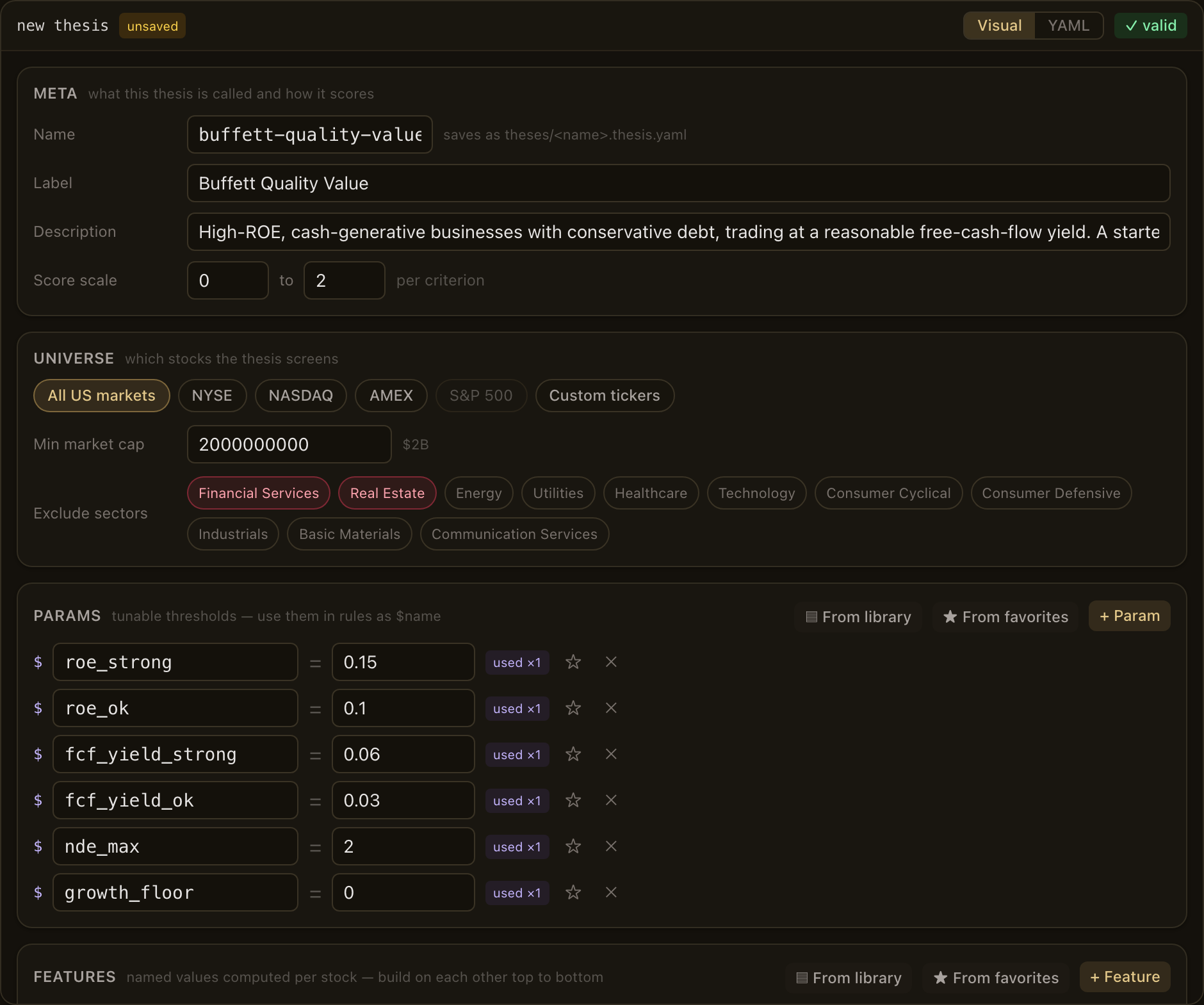
A thesis is a small, readable spec, and the visual builder writes it for you: pick a starter template, set the universe with a click, and tune named thresholds instead of editing formulas. Below — the Buffett-style quality-value starter, exactly as it opens in the app.
Tune, don't program
Every threshold is a named parameter — the ROE floor, the free-cash-flow-yield bands, the leverage cap. Change a number, re-scan, and see what it does to the survivor list. Exchanges, market-cap floor, and excluded sectors are one click each.
One line or thirteen features
The same engine runs a single-criterion idea or a full multi-factor model. This starter compounds thirteen computed features — trailing cash flows, revenue growth, leverage ratios — into four scored criteria, a strict quant gate, and three qualitative criteria for the optional AI pass.
Versioned like it matters
Saving creates an immutable version, and every scan and backtest records which version produced it. Tweak the thesis all you want — old results stay reproducible.
What you get
-
Unlimited backtesting
Run as many walk-forward backtests as you want — no per-run metering, no credits, no caps. Event studies plus a naive portfolio, benchmarked against SPY or IWM (one benchmark per run).
-
Flexible thesis building
The screen engine takes anything from a simple one-line idea to a complex multi-factor thesis — universe, features, scoring criteria, gates, verdict bands. Start from a template (deep-value, Graham net-net, Piotroski, Magic Formula, Buffett quality, earnings-yield), then bend it into your own.
-
Screen the whole US market
Rank the entire US equity universe against your thesis, then drill into any name. Your criteria, your gates, your verdict bands — not a black box.
-
A head start out of the box
Ships seeded with primary-source, point-in-time SEC fundamentals and the US equity universe, plus every thesis template — so you can build and screen from day one. Add prices (Financial Modeling Prep) and options history (back to 2008, via Alpha Vantage) by connecting your own data keys.
-
Point-in-time & survivorship-aware
Backtests see only what was known on each date, and keep delisted names in the historical universe. Honest by construction — no look-ahead, and survivorship-defended: from the day you start recording daily universe snapshots forward it's leak-free, and best-effort (clearly flagged) for reconstructed earlier history.
-
Optional AI scoring
Bring your own AI — Claude, OpenAI, or a local model — to score qualitative criteria on survivors. Or run quant-only, with no AI and no keys at all.
Bring your own keys
Quantery talks to data and AI providers with your API keys — stored locally, used directly from your machine. No proxy, no markup, no lock-in. Lean on free tiers, or run with no keys at all.
Market & fundamentals data
- SEC EDGAR Free · primary-source, point-in-time fundamentals
- Financial Modeling Prep Prices, the US universe & market data
- Alpha Vantage Historical options chains back to 2008
More data sources planned — see the roadmap.
AI scoring optional
- Anthropic — Claude Your API key, or your Claude subscription via the Claude CLI
- OpenAI Your API key, or your ChatGPT subscription via the Codex CLI
- Local models Ollama, LM Studio, llama.cpp, vLLM — fully offline
- No AI Quant-only scans need no AI and no keys
More providers planned — see the roadmap.
What each connection is used for
| Source | Point-in-time fundamentals | Prices & market data | Options chains | AI scoring |
|---|---|---|---|---|
| SEC EDGAR free | ✓ | — | — | — |
| Financial Modeling Prep | ✓ | ✓ | — | — |
| Alpha Vantage | — | — | ✓ back to 2008 | — |
| Anthropic — Claude API key or Claude CLI | — | — | — | ✓ |
| OpenAI API key or Codex CLI | — | — | — | ✓ |
| Local models Ollama, LM Studio, … | — | — | — | ✓ |
| Tradier Integration coming soon | — | — | planned | — |
| Polygon Integration coming soon | — | — | planned | — |
Checkmarks show what ships today. Rows marked “Integration coming soon” are planned, not live — the options-chain layer is being built as a pluggable interface with multiple backends. Details on the roadmap.
AI that reads the survivors — not a black box
The quant screen does the ranking. Then — only if you want — your own AI scores the qualitative criteria in your thesis on the names that survive: the judgment calls a ratio can't capture. Bring your own key or subscription, or a fully local model. Quant-only works with no AI and no keys at all.
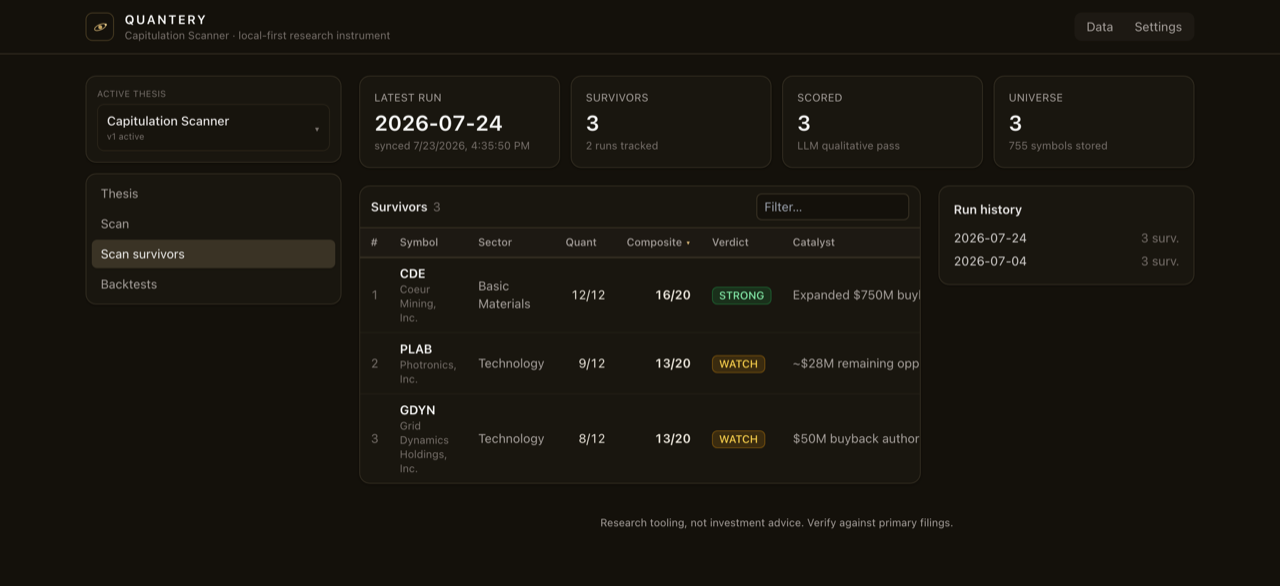
What AI does in Quantery today
- Scores your thesis's qualitative criteria on each screen survivor
- Folds into a composite score next to the quant rank — you see both
- Runs with your Claude or OpenAI key, your Claude/ChatGPT subscription, or a local model
- Entirely optional — every screen and backtest works with zero AI
Your keys stay on your machine and the app calls your provider directly. Choose a local model and nothing leaves your hardware.
Open any survivor for the full workup
Every row in the table drills into a per-ticker page: the scorecard, every thesis metric charted from point-in-time history, and the agent's notes with the sources it cited. These are real captures of the STRONG name from the scan above.
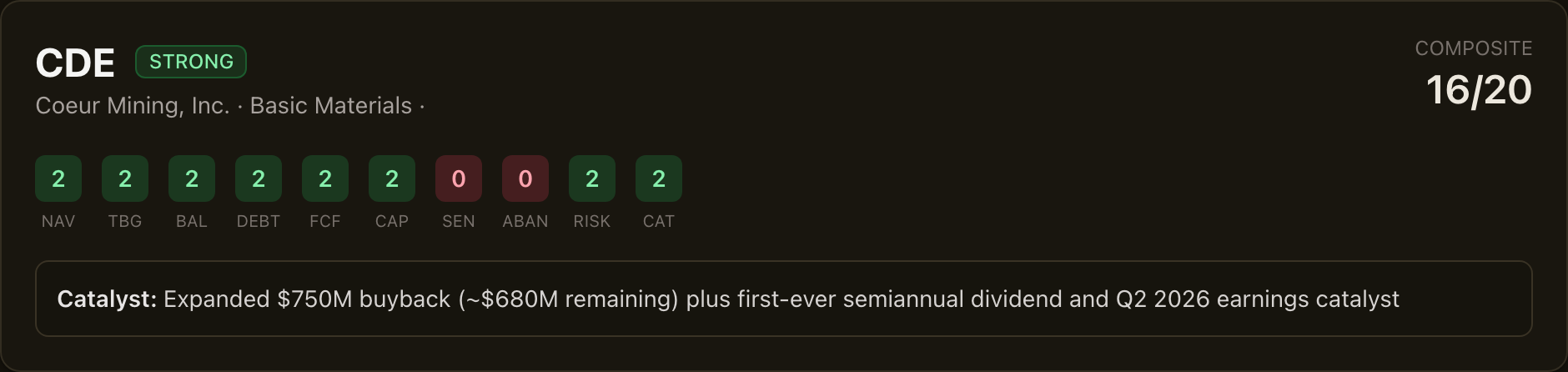
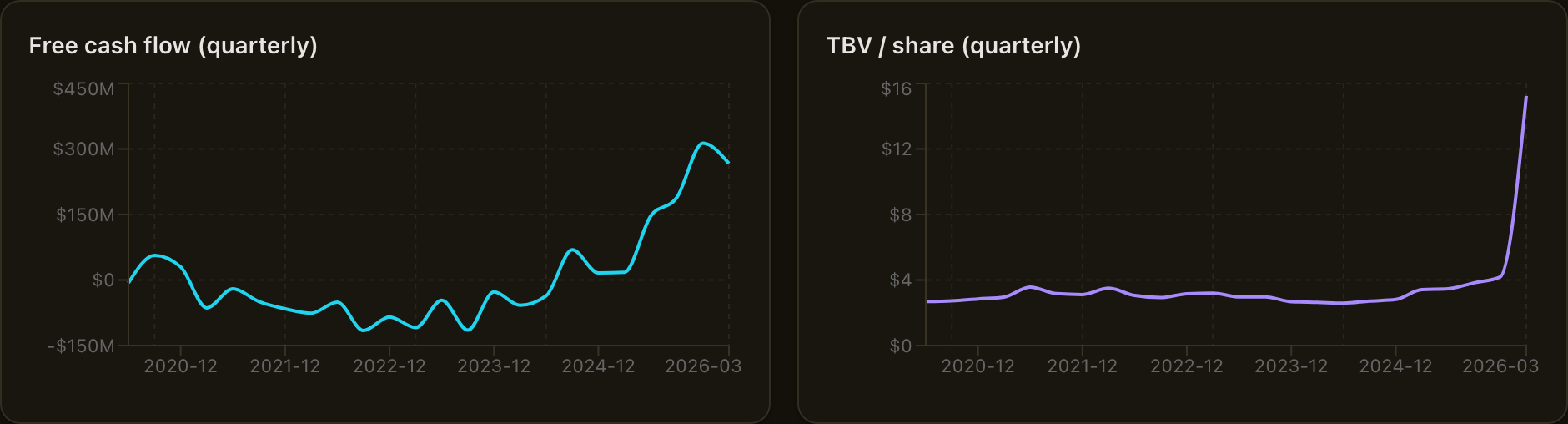
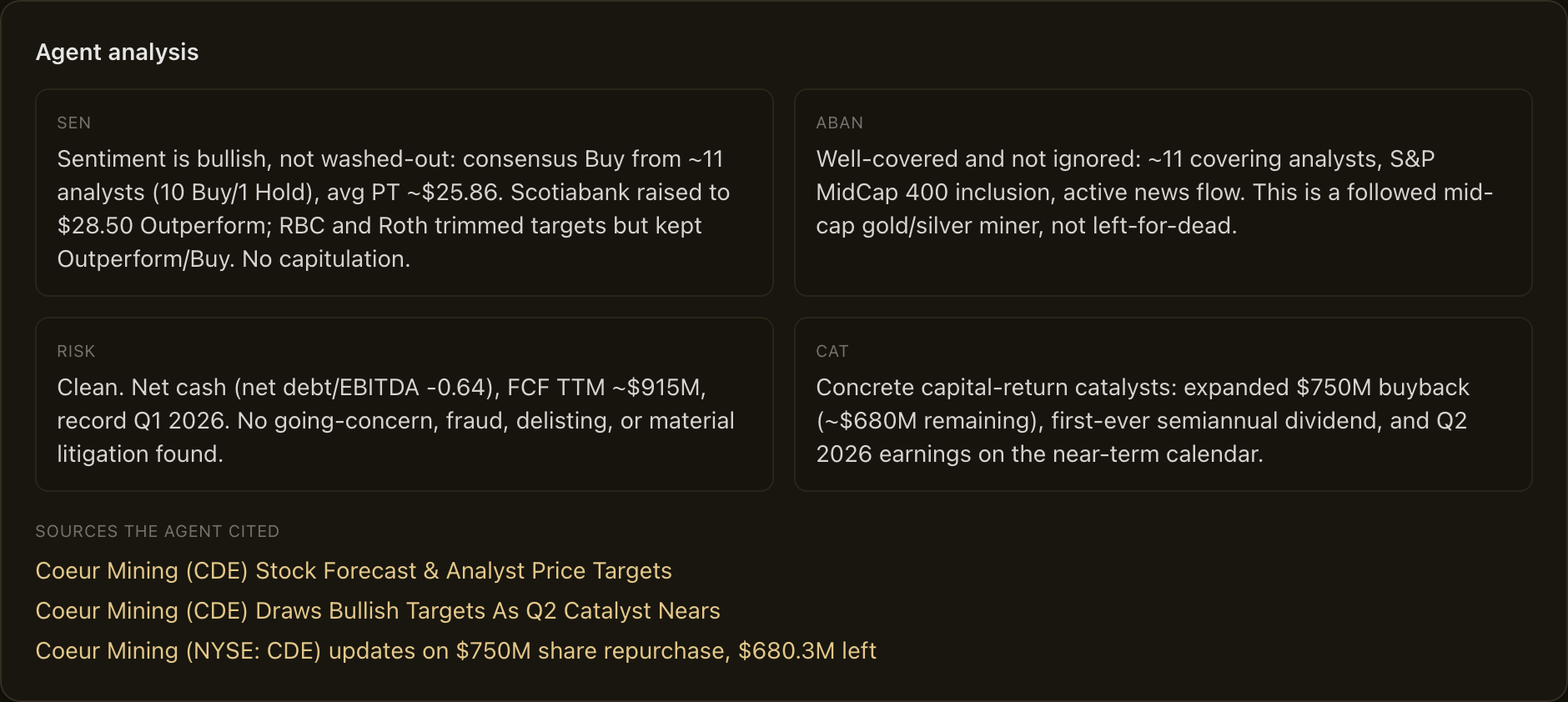
Real captures, one scan, zero mockups — click any shot to view it full screen. Example output, not a recommendation.
Coming soon Roadmap
An AI MCP server + thesis-building tools. Describe a strategy the way you'd say it out loud — a plain-language statement, an existing strategy you follow, even a formula — and the thesis tools convert that language into a quantitative screen you can run and backtest immediately.
You say “Profitable small caps trading under tangible book value, down big from their highs, with enough cash to ride out two lean years.”
You get A runnable screen: small-cap universe band · price/tangible book < 1 · positive trailing earnings · drawdown gate from the 52-week high · cash-runway requirement — ready to scan point-in-time and backtest walk-forward.
In development, not shipped yet — track it on the roadmap, and tell us what you'd want it to build first via the Feature Request button in the app's Settings.
Pricing
Honest and simple: one checkout, one perpetual license you own forever, with your first year of updates & support included. It continues at $99/year — cancel anytime, and your license stays perpetual either way.
Quantery
Regular price $499 , introductory price $249 one-time
Introductory launch price — rises to $499
Perpetual license
- Buy once, own it — works offline forever
- First year of updates & support included
- Your own API keys; your data never leaves the machine
- All thesis templates + unlimited theses of your own
- Point-in-time scans & walk-forward backtests
- macOS, Windows & Linux
Secure checkout via Lemon Squeezy. Renews at $99/year from year two — cancel anytime and keep the app forever.
Support & Upgrades
Included first year
then $99 / year — cancel anytime
Annual support & upgrade rights
- New versions & data-source updates as they ship
- Priority support
- Gates downloads only — never the app you own
- Lapses gracefully to a fully-working point-in-time build
Part of the same purchase — nothing extra to buy today. Cancel renewal anytime; your base license stays perpetual whether or not it renews.
Data-honest by design
- Research tooling, not investment advice. Quantery helps you test ideas; it does not tell you what to buy.
- Your keys and data stay on your machine. No proxy, no phone-home for your research, no lock-in.
- Verify against primary filings. Fundamentals come from SEC EDGAR; demo mode ships clearly-labeled fictional data.
Download
Quantery runs on macOS, Windows, and Linux. Download free, activate with the license key from your purchase email.
Go to downloads